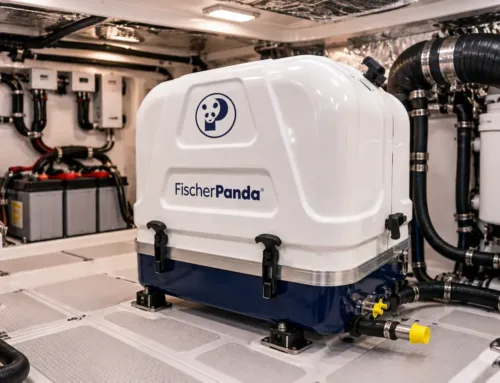


If you have ever compared marine generators side by side, you may have noticed that Fischer Panda units look noticeably smaller than the competition. That is not a coincidence. The reason comes down to one core engineering decision: 100% fresh water cooling. Understanding how it works helps explain why it produces better results across the board, from size and noise to durability and long-term performance.
How Air-Cooled Generators Work and Why It Limits Them
Most conventional generators rely on airflow to cool the engine and alternator. That means the unit needs open vents, airflow paths, and enough surrounding space for heat to escape. The result is a larger, heavier footprint that generates more noise because the moving air and mechanical components have no enclosure to muffle them.
How Fresh Water Cooling Changes the Equation
- Because cooling is handled through a closed-loop freshwater system rather than ventilation-based cooling, the generator can be housed in a fully insulated sound enclosure while still providing the necessary airflow for engine combustion.
- The insulated sound enclosure minimizes noise transmission while maintaining the airflow required for engine operation. which is why Fischer Panda generators operate as quietly as 52 dBA at 23 feet
- The compact design allows installation in spaces where larger conventional marine generators may not fit. Internal temperatures stay stable and controlled regardless of the ambient environment
Corrosion Protection in a Marine Setting
What This Means for Installation
The practical benefit of a compact, fully enclosed design is real space savings onboard. Engine rooms and under-deck compartments are at a premium on any vessel. A generator that does not need airflow clearance on all sides fits into tighter spaces and leaves more room for other systems. For liveaboards and long-range cruisers, that flexibility in layout matters.
The Bottom Line
Fresh water cooling is not just a feature. It is the foundation of what makes Fischer Panda generators smaller, quieter, and more durable than the alternatives. It is the reason the same unit that delivers 8 kW of reliable AC power can fit comfortably in a space that a conventional generator simply could not.

Instant answers, expert support—right from your pocket. Download the Fischer Panda Ethan App now.