
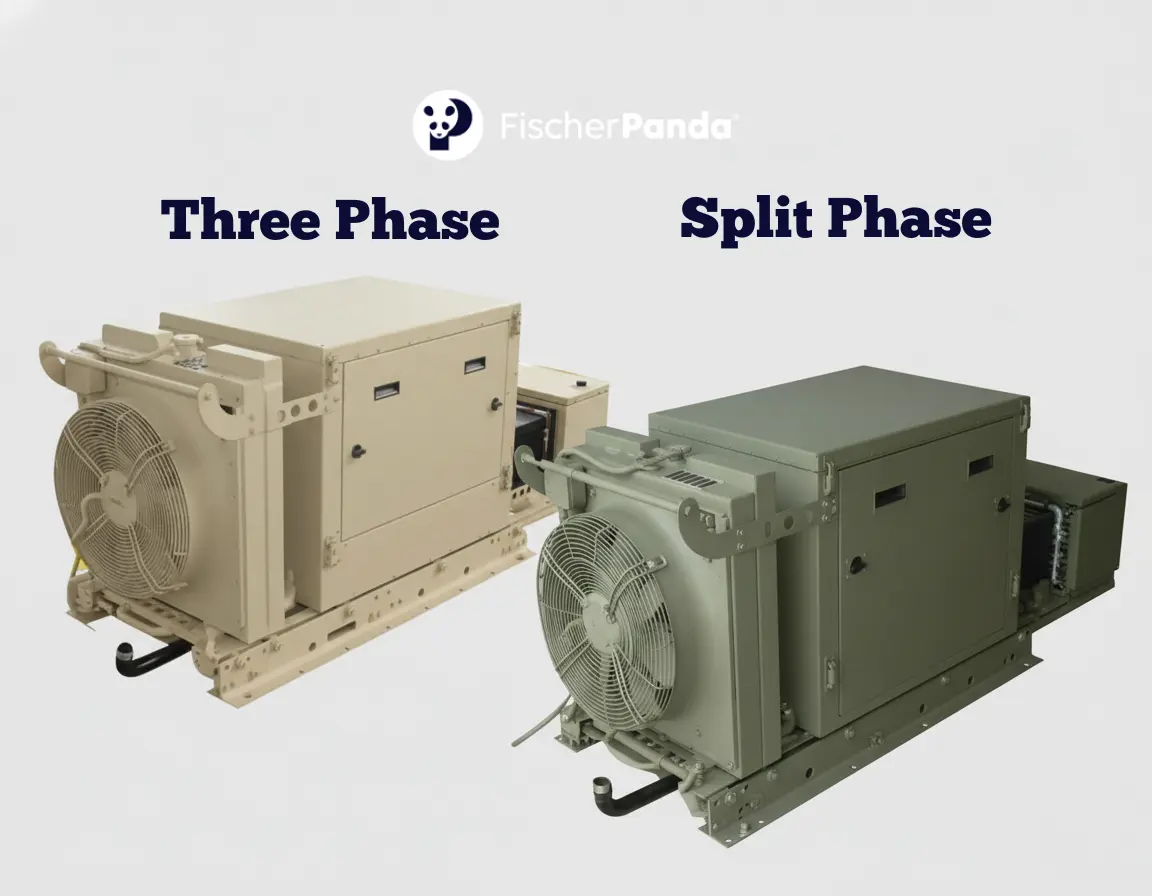
When selecting a military-grade power system, understanding how electricity is delivered to your equipment is just as critical as knowing how much power you need. Fischer Panda’s SST 10kW Tunnel Generator Series is available in two configurations: Split Phase (120/240V) and Three Phase (120/208V), each designed to meet specific operational demands.
Both systems share Fischer Panda’s hallmarks of quiet operation, liquid-cooled technology, and compact design, but their internal power distribution makes them uniquely suited to different missions. This guide breaks down the differences to help you choose the right SST 10kW generator for your application.
Understanding the Core Difference
At their core, split phase and three phase systems both deliver the same total power output. The difference lies in how that power is transmitted.
-
Split Phase Generators use three wires – two hots and one neutral – to deliver power in a single alternating current cycle. This configuration is ideal for standard military equipment, lighting systems, and communications units that don’t require balanced, high-load distribution.
-
Three Phase Generators use three live wires and a neutral, each 120° apart in electrical phase, to deliver smoother and more efficient power. This makes them ideal for high-demand systems, field hospitals, and mobile command units running multiple devices simultaneously.
In short:
-
Split phase = Offers simplicity and reliability for smaller systems. Best suited when most major components do not support three-phase power, as split-phase reduces the need to balance loads across individual legs.
-
Three phase = Provides higher efficiency and stability for heavy, continuous, or motor-driven loads, such as large fans commonly used in ECU (Environmental Control Unit) applications.
Power Configuration Comparison
| Feature | SST 10kW Split Phase | SST 10kW Three Phase |
|---|---|---|
| Voltage | 120/240V AC | 120/208V AC |
| Amperage | 102A / 51A | 34A per phase |
| Noise Level | 57 dBA @ 23 feet | 57 dBA @ 23 feet |
| Weight | 759 lbs (wet) | 759 lbs (wet) |
| Cooling System | 100% liquid-cooled (engine + alternator) | 100% liquid-cooled (engine + alternator) |
Both versions feature Fischer Panda’s asynchronous alternator, meaning no brushes, slip rings, or diodes – drastically reducing maintenance needs and ensuring exceptional longevity.
Choosing Based on Application
When to Choose the Split Phase SST 10kW
The Split Phase 120/240V version is designed for standard military and tactical vehicles where simplicity and compatibility are essential. It’s ideal if:
-
Your equipment runs primarily on single-phase power
-
You need fewer electrical components and wiring complexity
-
You power systems like lighting and communication
-
You require seamless integration into existing HMMWV SICPS setups
This model provides direct, reliable power to individual systems, ensuring ease of use and maintenance in the field.
When to Choose the Three Phase SST 10kW
The Three Phase 120/208V version is better suited for missions requiring balanced and distributed power, especially across multiple shelters or vehicles. It’s ideal if:
-
You run several high-load devices simultaneously (computers, comms, environmental systems)
-
Your operation requires stable voltage under changing loads
-
You need greater efficiency and reduced energy loss for sustained operations
-
You’re supporting large-scale installations such as field hospitals, command centers, or radar systems
Three-phase systems deliver a smoother, more consistent energy flow while reducing stress on motors, compressors, and sensitive electronics.
Shared Fischer Panda Advantages
Regardless of configuration, both SST 10kW Tunnel Generators are built to meet the same demanding standards that define every Fischer Panda product.
- Ultra-Quiet Operation: Just 57 dBA @ 23 feet for low acoustic signature.
- Asynchronous Alternator: No brushes, diodes, or slip rings – reducing maintenance and extending lifespan.
- 100% Liquid Cooling: Engine and alternator are both water-cooled for consistent operation in extreme conditions.
- EMI Hardened: Shielded against electromagnetic interference to protect sensitive onboard systems.
- Digital Diagnostics: Smart monitoring and fault detection improve reliability and ease of service.
- Mission-Ready Safety: Includes automatic shutdowns, manual emergency stop, and a battle short switch.
Built for Tactical Mobility and Durability
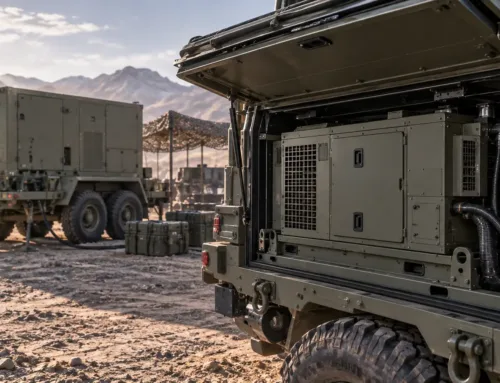
Both SST 10kW models are designed for rapid deployment, reduced heat signatures, and exceptional portability. At just 759 lbs (wet), they integrate seamlessly into vehicle bays, shelters, and trailers without requiring additional sound abatement.
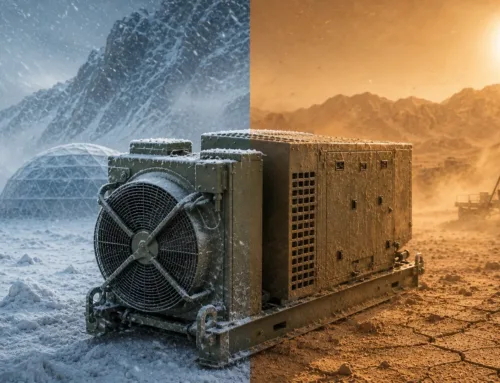
With their compact design and advanced cooling systems, Fischer Panda generators operate effectively in temperature extremes ranging from -40°F to 120°F, making them a dependable power source in desert, arctic, or jungle environments alike.
Fischer Panda’s Legacy of Military-Grade Power
Fischer Panda has been a trusted name in mobile power solutions for decades, engineering systems that combine compact efficiency with rugged durability. The SST 10kW Split Phase and Three Phase models continue that tradition – offering precision-built, low-noise generators capable of supporting both defense and humanitarian missions.
If you’re looking for the perfect power system for your application, start by evaluating the type of load you’re running, not just the wattage required.
-
Choose Split Phase for simple, standalone installations where no 3-phase consumers are planned.
-
Choose Three Phase for efficiency and multi-system operations.
Explore Both SST 10kW Models
Both represent Fischer Panda’s commitment to quiet, compact, and efficient power systems for mission-critical environments.
FAQ: Split Phase vs Three Phase Generators
Q1: What’s the main difference between split and three phase power?
Split phase delivers one alternating current cycle, ideal for smaller systems. Three phase delivers three synchronized currents, providing smoother, more stable power for heavy loads.
Q2: Can I run split phase equipment on a three phase generator?
Yes, with the proper wiring or transformer setup. In some cases, Split-phase equipment that supports 208 VAC / 60 Hz can operate across two legs of a three-phase system, just be sure to keep the load balanced. For best results, match the generator phase to your primary equipment.
Q3: Which type is better for tactical shelters or field operations?
Split phase is simpler and more versatile for smaller command units, while three phase is preferred for distributed operations requiring balanced power across multiple systems.

Instant answers, expert support—right from your pocket. Download the Fischer Panda Ethan App now.