
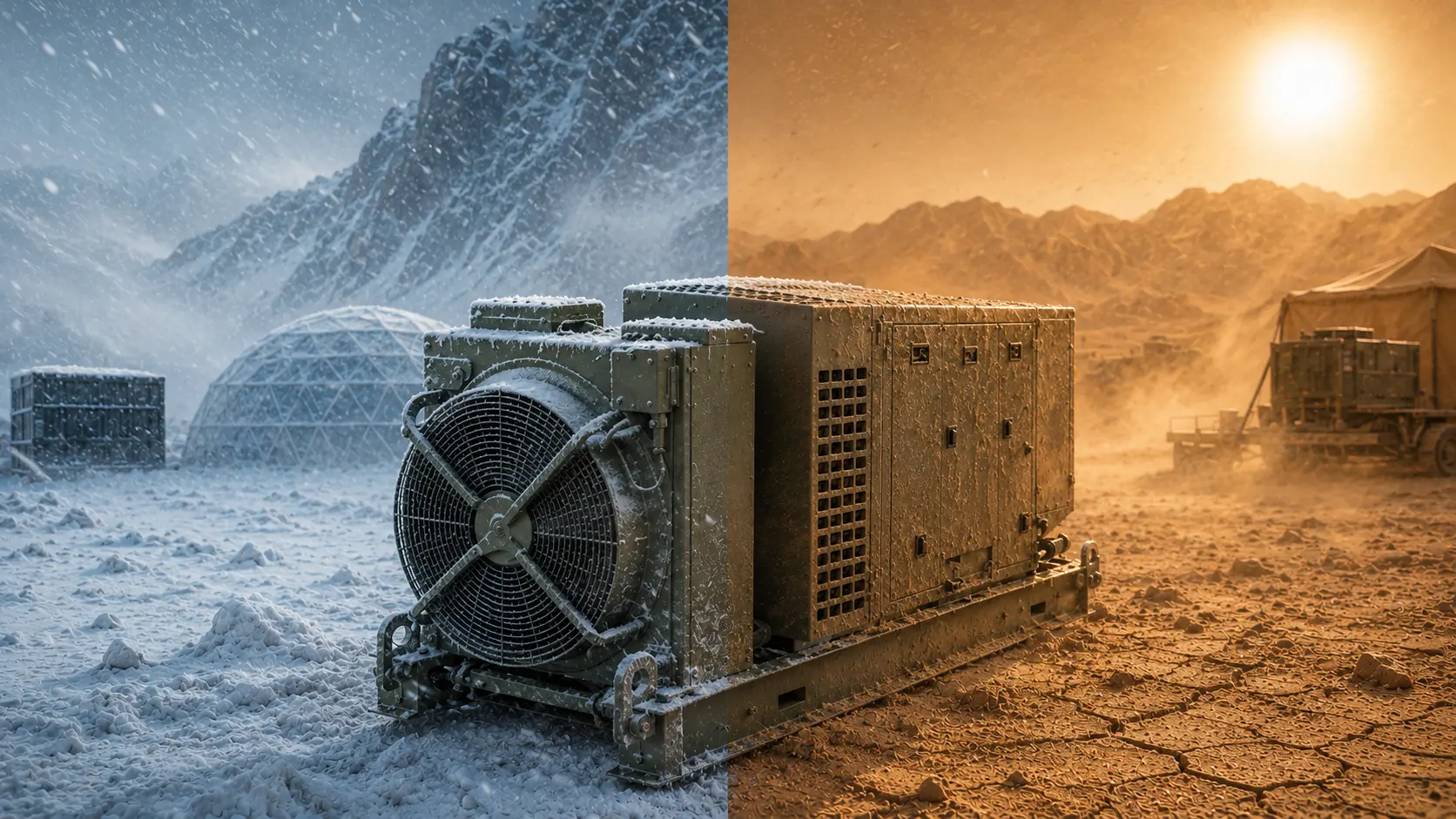
Modern military operations do not happen in controlled conditions. From Arctic cold-weather exercises to desert deployments at high altitude, the environments where generators and APUs are required to perform continuously are some of the most demanding on earth. As operational theater requirements expand and equipment failure becomes less acceptable, the MIL-SPEC standards governing generator power systems are not simply compliance checkboxes, they are the baseline for mission success.
Here is a breakdown of the specifications that matter most when generators and APUs operate in extreme environments.
The Temperature Challenge: Arctic Cold and Desert Heat
No two environments test a generator more differently than Arctic cold and desert heat, yet both have become standard deployment conditions for U.S. and allied forces.
At the cold end of the spectrum, generators must be capable of cold-starting and reaching full operational output at temperatures as low as -49°F ( -45°C). At these temperatures, fuel viscosity increases, battery cranking power decreases, and conventional lubrication systems struggle to circulate properly during startup. A generator that cannot reliably cold-start cannot support the mission.
At the opposite extreme, generators must maintain continuous output at temperatures up to 131°F (55°C) while operating at elevations of 9,843 feet (3,000 meters). High temperatures combined with reduced air density create significant thermal management challenges that many conventional cooling systems cannot overcome.
Fischer Panda military generators are engineered and tested to perform across this entire operating range, from below -49°F (-45°C) to above 131°F (55°C), while maintaining reliable performance in demanding environments.
MIL-STD-810: Environmental Durability
MIL-STD-810 establishes the environmental engineering and laboratory testing requirements for military equipment. For generators and APUs operating in harsh environments, some of the most important test methods include:
- Low-temperature storage and operation testing to validate cold-start capability and sustained performance in Arctic conditions.
- High-temperature and solar radiation testing to verify cooling system performance in desert environments.
- Humidity, rain, and immersion testing to protect internal components across varying climates.
- Sand and dust testing to ensure airborne particulates do not degrade performance or accelerate wear.
- Altitude testing to confirm reliable operation where reduced air density affects engine performance.
- Vibration and shock testing to withstand transport over rough terrain and vehicle-mounted deployment.
A generator intended for Arctic or desert operations that has not been validated to MIL-STD-810 represents unnecessary operational risk.
MIL-STD-461: Electromagnetic Compatibility
Electromagnetic interference (EMI) requirements remain critical regardless of climate, but their importance increases in harsh operating environments where reliable communications and navigation systems are essential.
MIL-STD-461 compliance, including the MIL-STD-461F requirements Fischer Panda designs, helps ensure that generators do not interfere with nearby communications, navigation, or targeting systems. Fischer Panda’s AGT5000 PE-150 28V DC generator is both EMC and IR tested to meet these demanding operational requirements.
Liquid Cooling for Extreme Environments
Thermal management is one of the greatest challenges for generators operating in extreme climates.
Air-cooled generators rely on ambient air to remove heat. In desert environments, elevated air temperatures reduce cooling efficiency, while in Arctic conditions, moisture and ice can create additional reliability concerns.
Fischer Panda’s fully liquid-cooled design overcomes these challenges by circulating coolant through a closed-loop system that independently manages engine and alternator temperatures. As the only fully liquid-cooled asynchronous military generator available in the United States, Fischer Panda maintains stable operating temperatures whether deployed in desert heat or Arctic cold.
Managing Acoustic and Thermal Signatures
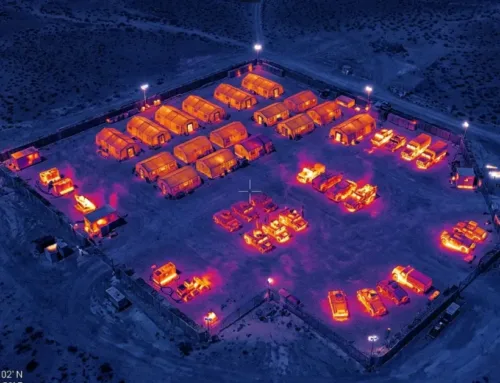
Extreme environments also increase the importance of acoustic and infrared signature management. Sound can travel farther across frozen terrain, while thermal contrast makes equipment more visible to infrared detection systems. Desert operations present similar thermal detection challenges.
Fischer Panda generators address both through their fully encapsulated construction and liquid-cooled exhaust muffler, reducing both operating noise and thermal emissions. The SST-10 operates at just 57 dBA measured at 23 feet while maintaining a reduced infrared signature suitable for tactical environments.
Key Takeaways for Defense Procurement
As military operations continue expanding into increasingly demanding environments, compliance with MIL-STD-810 and MIL-STD-461 is becoming a fundamental requirement rather than a preferred feature. Generators and APUs that cannot demonstrate validated performance under extreme temperatures, sand and dust exposure, high-altitude operation, vibration, shock, and electromagnetic compatibility are increasingly being eliminated from procurement consideration.
For procurement teams evaluating generators or APUs for harsh-environment deployments, Fischer Panda’s engineering team is available to discuss mission-specific requirements and customized power solutions.
Call 1-800-508-6494 to speak with a military power systems specialist.

Instant answers, expert support—right from your pocket. Download the Fischer Panda Ethan App now.